

Given the root of a binary tree, invert the tree, and return its root.
Input: root = [4,2,7,1,3,6,9]Output: [4,7,2,9,6,3,1]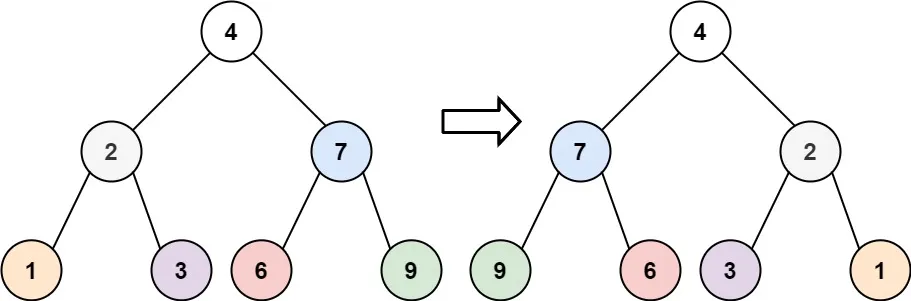
Solution
Section titled “Solution”Use a recursive function to invert the tree. The function will swap the left and right child of the current node, and then recursively invert the left and right child nodes.
Implementation
Section titled “Implementation”function invertTree(root) { if (root === null) { return null; }
const left = invertTree(root.left); const right = invertTree(root.right);
root.left = right; root.right = left;
return root;}function invertTree(root: TreeNode | null): TreeNode | null { if (root === null) { return null; }
const left = invertTree(root.left); const right = invertTree(root.right);
root.left = right; root.right = left;
return root;}func invertTree(root *TreeNode) *TreeNode { if root == nil { return root }
left := invertTree(root.Left) right := invertTree(root.Right)
root.Left = right root.Right = left
return root}Pseudocode
Section titled “Pseudocode”- If the root is null, return null
- Recursively invert the left and right child nodes
- Swap the left and right child nodes
- Return the root node
Complexity Analysis
Section titled “Complexity Analysis”- The time complexity of this algorithm is O(N), where N is the number of nodes in the binary tree.
- The space complexity of this algorithm is O(N), where N is the number of nodes in the binary tree.